What Your Money Actually Buys on Lake Austin
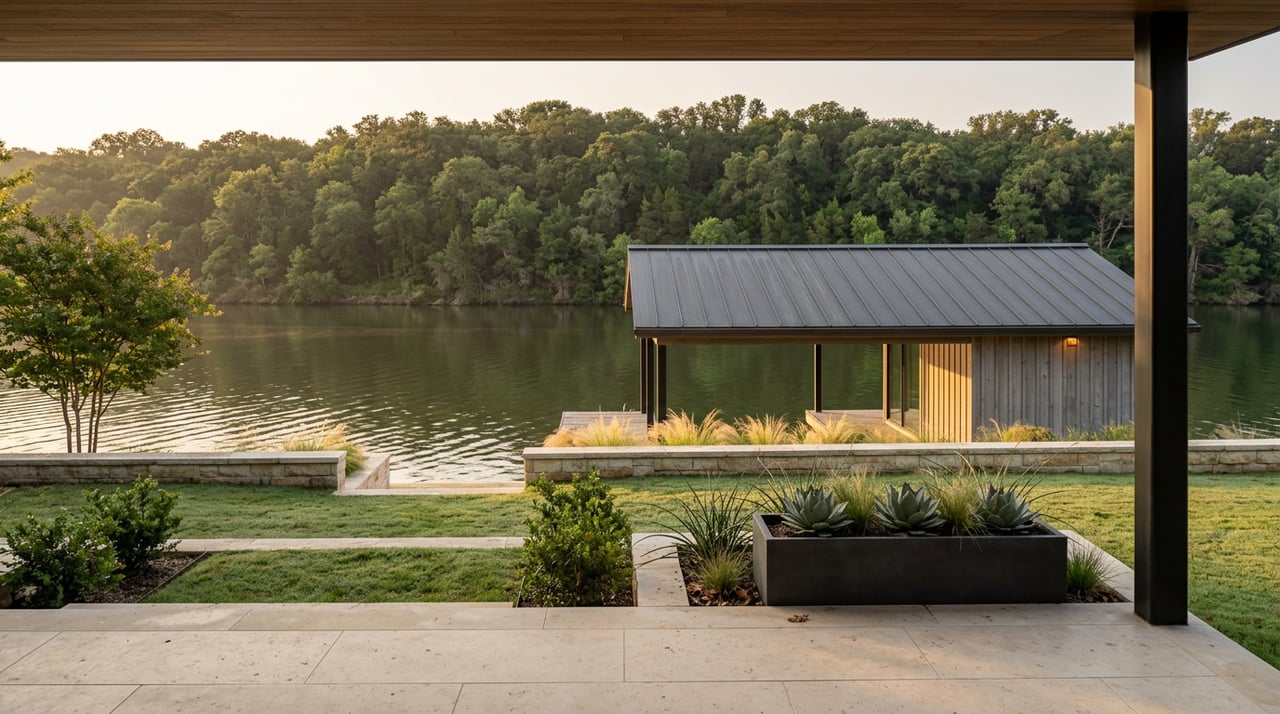
A buyer comparing a $4 million older waterfront to a $15 million estate on Edgewater Drive usually assumes the delta is square footage, finish level, and view. It rarely is. The most valuable asset on Lake Austin is not measured in bedrooms. It is a permitted, transferable connection to the water, and the rules governing that connection are stranger than the listing photos suggest.
This is a market where a boathouse can be worth more than a wing of the house, and where a well-intentioned renovation can permanently reduce what a property is allowed to be.
Headline pricing on Lake Austin sits in a wide band. Older waterfront homes and difficult lots typically start around $4 million to $5 million, while prime flat lots with modern estates run $8 million to $15 million, with a handful of trophy properties reaching $25 million and above. Recent inventory illustrates the top of that curve: a nine-acre waterfront estate at 2503 Edgewater Drive is asking $15 million, and 4625 Rockcliff Road, set between Austin Country Club and a small cove, is asking $19 million. 1901 Westlake Drive has been marketed as a potential record-setter for the city's highest publicly recorded residential sale.
The instinct is to explain that gap through architecture. The more accurate explanation is regulatory. Every one of those price points is really a bid on shoreline rights, and those rights are not evenly distributed along the 22 miles between Mansfield Dam and Tom Miller Dam.
On Lake Austin, you are not buying feet of frontage. You are buying what the City of Austin, the Lake Austin Overlay, and a prior owner's paperwork will let you do with those feet.
Most buyers arrive assuming the Lower Colorado River Authority governs the shoreline. On Lake Travis, it does. On Lake Austin, jurisdiction shifts in a way that catches out-of-market buyers and even some agents.
The City of Austin is responsible for management of Lake Austin dock and safety regulations, and LCRA directs dock questions to the Austin Parks and Recreation Department at 512-974-6700. That single detail rearranges due diligence. Permit files, dock registrations, and modification approvals live with the City, not the river authority, and they are not always where a title company thinks to look.
The layering does not stop there. Inside Austin city limits, land development, environmental, and building rules can apply, including impervious cover limits, tree protections, hillside or water quality overlays, and permits for building work; in unincorporated Travis County, county building, septic, and floodplain rules govern instead, and jurisdiction has to be confirmed for each parcel because rules differ. Two lots on the same cove can operate under different rulebooks.
The Lake Austin Overlay is the least discussed line item in most listing presentations, and the most consequential.
Though Lake Austin runs about 20 miles, true private waterfront is limited by geography, existing ownership, public parkland, older roads, steep banks and protected coves, and the city's Lake Austin overlay adds another layer of limitation, regulating how owners can build near the water, including the size, placement and expansion of homes, docks, bulkheads and other shoreline improvements within 1,000 feet of the lake.
Read that carefully. The overlay does not stop at the waterline. It reaches 1,000 feet inland, which on many lots covers the entire buildable envelope. A renovation that would be routine in Tarrytown or Old West Austin can trigger a different set of approvals here. Expansion plans that assume standard Austin zoning are frequently the source of the friction that surfaces during a transaction, not before.
For a buyer, this reframes what a "development lot" is worth. Two parcels with identical frontage can carry very different entitlements, and the more valuable one is often the parcel with older, already-approved structures that a new owner can maintain rather than one requiring fresh review.
This is where the Forbes coverage of 1901 Westlake becomes instructive rather than aspirational. At 1901 Westlake Drive, modern architecture, a billiards room and bar, and a grandfathered boathouse turn a prized lake position into a fully fledged trophy estate. The grandfathered boathouse is not a design flourish. It is a legal artifact that a rebuild would likely erase.
The mechanism is worth stating plainly. If a storm damages a dock, an owner may need to notify LCRA before repairs or seek a permit amendment; emergency stabilization might be allowed in some cases, but rebuilding a destroyed dock often triggers current rules, and a rebuild can remove any prior grandfathered status, which changes what an owner can restore. The same logic applies to boathouses and covered slips under City of Austin review. A structure that could not be permitted new today is worth a premium precisely because it exists.
That premium is measurable. On the broader Highland Lakes market, homes with fully permitted docks command $50,000 to $150,000+ premiums over properties without docks, and on Lake Austin, where a covered boathouse would face far stricter review if proposed today, the delta compounds.
Two follow-on rules matter for buyers evaluating what transfers with a sale:
| Structure | Status question a buyer should ask |
|---|---|
| Open dock | Is the City of Austin registration current, and does the footprint on file match what is in the water? |
| Covered boathouse | Was it built under a prior regulatory regime, and would today's rules allow it to be rebuilt if lost? |
| Bulkhead or seawall | Does the permit file include the shoreline stabilization, or is it undocumented? |
| Lift or watercraft platform | Are additions since the original permit reflected in the file? |
Some authorizations can transfer to a new owner, and others require formal notification or reapplication; transferability should not be assumed, and buyers should ask for written confirmation and obtain full permit files from the seller.
Lake Austin's other structural advantage is the reason many buyers cross-shop it against Lake Travis and then commit to Austin anyway. Lake Austin is a constant-pool lake held within a tight range, which simplifies some elevation decisions but introduces others; the water is always close, drainage matters, and bulkhead detailing is part of nearly every build, and lots tend to be flatter and more developed.
The financial translation of "constant pool" is usable days. A dock that works in February works in August. A boathouse floor does not sit 40 feet above the waterline for half the year. That predictability is what supports the price gap between the two lakes and part of what supports the delta between waterfront and view-only properties within Lake Austin itself. Entry-level condos and view homes without water access typically trade in the $600,000 to $1.2 million range, while true waterfront begins around $4 million to $5 million and prime estates run into the $15 to $25 million tier.
For the buyer, the takeaway is that a lift-serviced, permitted, deep-water slip on a constant-pool lake is not a category with meaningful substitutes elsewhere in central Texas.
None of this diminishes the reason people buy here. The south shore feeds into the Eanes Independent School District, downtown is roughly six miles east, and the lifestyle centers on lakefront entertaining, water sports, and social boating to boat-accessible restaurants like Ski Shores Cafe and Hula Hut. Proximity to the Austin Country Club anchors the Rockcliff and Edgewater stretches. New product is entering the market at the upper end as well, with gated enclaves like Caslano releasing waterfront, lake view, and ranch-style lots at ultra-luxury price points.
The point of leading with regulation is not that it overshadows the lifestyle. It is that two homes with the same view and the same finish level can be very different assets once the permit file is opened, and the reader should not learn that in option period.
Does LCRA issue dock permits for Lake Austin? Not for residential docks on this lake. The City of Austin is responsible for management of Lake Austin dock and safety regulations, and LCRA refers questions to the Austin Parks and Recreation Department. LCRA governance is more directly felt on Lake Travis and the other Highland Lakes.
Can a damaged boathouse be rebuilt as it stood? Not necessarily. Rebuilding a destroyed dock often triggers current rules, and a rebuild can remove any prior grandfathered status, which changes what an owner can restore. A structure that could not be permitted new today may not be replaceable in kind, which is why grandfathered configurations trade at a premium.
How does the Lake Austin Overlay affect a renovation? The overlay regulates size, placement, and expansion of homes and shoreline improvements within 1,000 feet of the water. Plans that would clear standard Austin review can require additional approvals here, and the envelope should be tested before contract, not after.
Is short-term rental income a reliable underwriting assumption? It should be verified parcel by parcel. If the home is inside Austin city limits, the city's short-term rental program and permit requirements apply; outside the city, rules vary, but county requirements, septic capacity, and HOA covenants still matter, and many waterfront communities restrict STRs, so municipal jurisdiction, current rules, and recorded deed restrictions should be reviewed before assuming rental income.
Lake Austin rewards patience and paperwork in roughly equal measure. The properties that hold their value are the ones whose permit files match their marketing, and the buyers who do best here are the ones who ask about the boathouse before they ask about the kitchen. If a specific address is on your list, or you would like a quiet read of what is trading off-market along the shoreline, Kumara Wilcoxon is available to review it with you.
Stay up to date on the latest real estate trends.

An Insider's Guide to Luxury Homebuying in Austin.

Ranked No. 1 in Austin, No. 2 in Texas, and No. 31 nationwide by 2026 RealTrends Verified sales volume.
Global Connections. Local Expertise. World Class Marketing.
Let me know how I can assist you.
